
Poker for Beginners: Understanding Hand Rankings and Basic Strategy
Poker rewards patience far more than nerve. Start with the hand rankings, the wagering rounds, and why the seat you sit in changes every decision.
By Dana Reyes, Games editor · Published Mar 18, 2026 · Updated Jul 30, 2026 · 8 min read
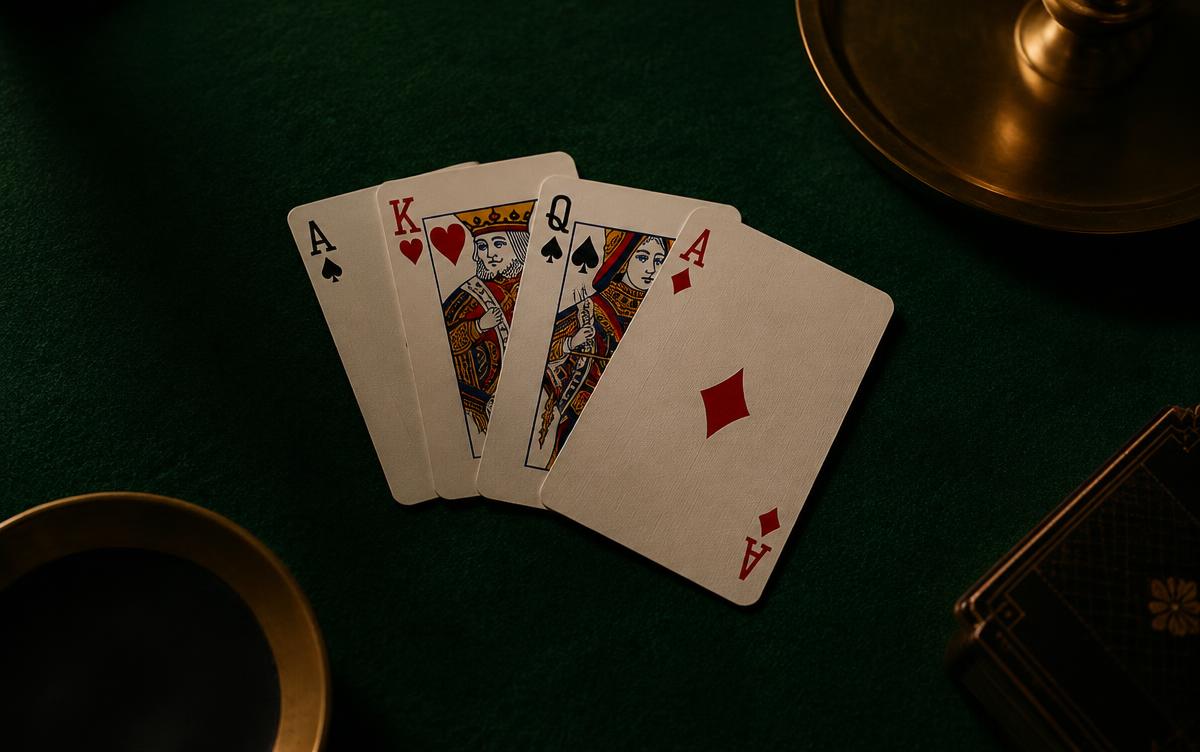
Poker for beginners really comes down to two skills: knowing which hand beats which, and knowing when it is cheap to find out. Everything else — the reads, the bluffs, the drama of a televised final table — sits on top of those fundamentals.
This guide uses Texas Hold'em, the most widely played variant, to explain the structure. Learn it once and most other variants become small adjustments.
Hand rankings, strongest to weakest
In Hold'em you make the best five-card hand from your two private cards and five shared community cards. You may use both, one, or neither of your own cards.
| Hand | What it is | Example |
|---|---|---|
| Royal flush | A to 10, all one suit | A♠ K♠ Q♠ J♠ 10♠ |
| Straight flush | Five in sequence, one suit | 9♥ 8♥ 7♥ 6♥ 5♥ |
| Four of a kind | Four cards of one rank | Q Q Q Q 3 |
| Full house | Three of a kind plus a pair | 8 8 8 K K |
| Flush | Five of one suit, any order | A♣ J♣ 9♣ 6♣ 2♣ |
| Straight | Five in sequence, mixed suits | 10 9 8 7 6 |
| Three of a kind | Three cards of one rank | 5 5 5 K 2 |
| Two pair | Two different pairs | J J 4 4 9 |
| One pair | Two cards of one rank | A A 7 5 3 |
| High card | None of the above | A Q 9 6 3 |
How a hand plays out
- Two players post forced wagers called blinds, then everyone receives two private cards.
- Pre-flop: the first round of wagering, starting left of the big blind.
- The flop: three community cards, then a wagering round.
- The turn: a fourth card, then a wagering round.
- The river: a fifth card, a final wagering round, then a showdown between remaining players.
Position is the quiet advantage
Acting last in a wagering round means you have watched everyone else's decision before making yours. That extra information is worth more than most starting hands. New players focus on their cards; steadier players focus on their seat.
The practical version of this: play more hands when you are late to act, and fewer when you are first. It is an unglamorous adjustment that quietly removes a lot of losing spots.
Starting hand discipline
Most beginners lose money by playing too many hands, not by playing strong hands badly. Big pairs, big suited cards, and connected high cards are playable almost anywhere. Weak offsuit combinations — a 9 and a 4 in different suits, say — are the hands that drain a stack over an evening.
Folding is a decision, not a failure. In a full game you will fold the large majority of hands, and that is exactly what the maths expects.
Pot odds in one paragraph
If there are 80 chips in the pot and calling costs you 20, you need to win roughly one time in five for the call to break even. Compare that break-even number to how likely your hand is to improve. This single comparison replaces most of what people imagine poker intuition to be.
If you want the background maths, our guide to the house edge explains the same underlying idea from the casino's side of the table.
Bluffing, realistically
Bluffing works when the story you are telling with your wagers is consistent and when your opponent is capable of folding. Against a player who calls everything, a bluff is just a donation. Beginners are usually better served by wagering good hands clearly and often.
About the author
Dana Reyes, Games editor
Dana has spent a decade writing rules explainers and probability breakdowns for beginners. She learned craps standing at a table with a printed cheat sheet and has been translating game maths into plain English ever since.
Share